
GEO rewards brands, not websites
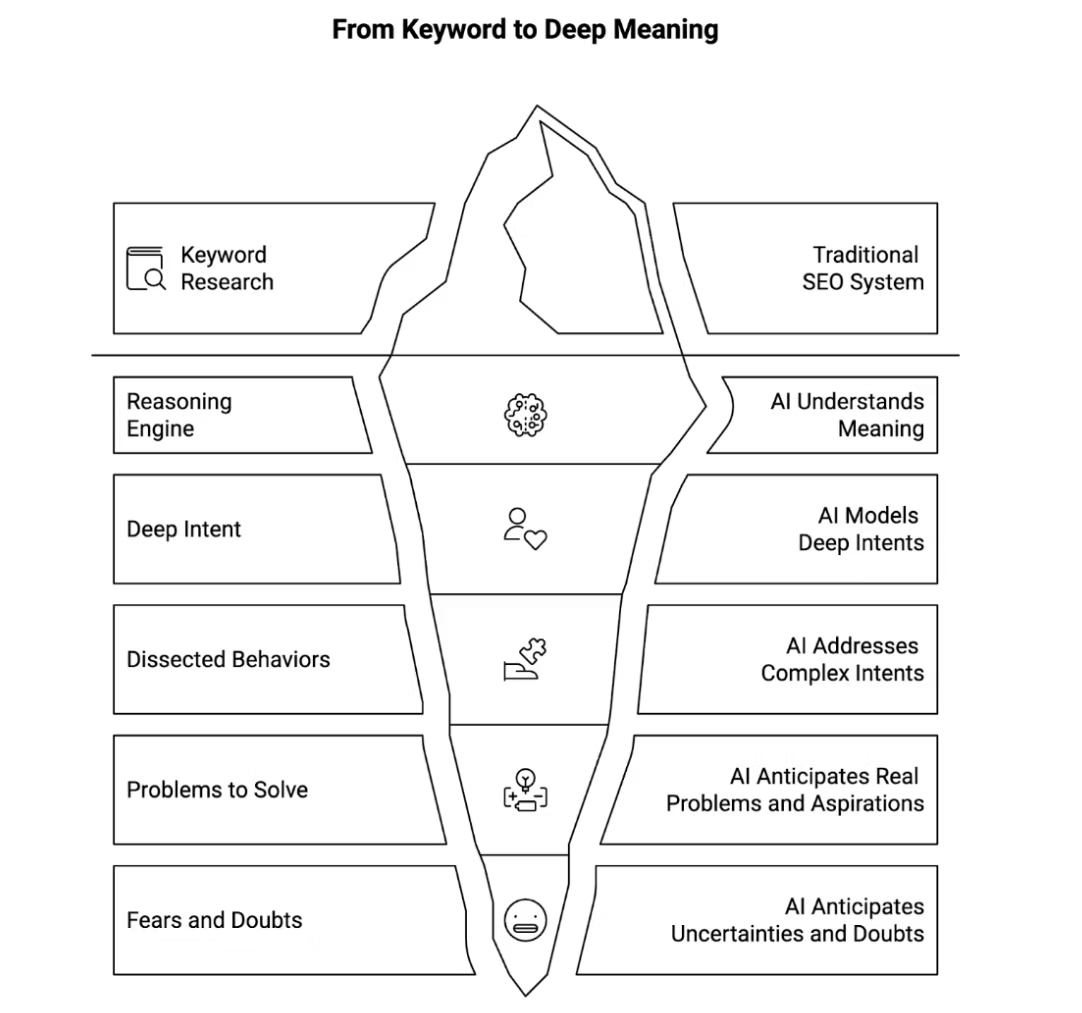
SEO produced a generation of websites optimized for algorithms and unreadable for humans. Keywords everywhere, architecture designed for bots, and at the center, a brand that nobody really knows what it solves or for whom.
For twenty years, this approximation was acceptable. Google ranked the most optimized pages. Traffic arrived despite the ambiguity.
LLMs close that window.
To select a source, a language model must understand exactly what you do, for whom, and how you differ from your competitors. If your positioning is generic, the AI has no reason to choose you among the dozen players saying the same thing with the same words.
This is the first diagnostic we run for every client: the gap between what the market is looking for and what the brand expresses. That gap is almost always significant. The real fears of prospects, their doubts, their decision criteria are rarely encoded in the brand discourse. In their place, generalities built on intuition, not on data.
In an LLM environment, that gap is no longer a relative weakness. It is a disqualification.
Filter 1: External credibility. What you write about yourself does not count
An LLM applies a first filter before any content analysis: external identity validation. It looks for convergence. Is your brand mentioned consistently by third-party sources: press, specialized forums, Wikipedia, LinkedIn, Crunchbase?
This filter reveals the futility of a certain reading of GEO that consists of over-optimizing your own pages. Your internal discourse, however brilliant, carries near-zero weight if no external source confirms your existence and expertise.
The backlink, a pillar of traditional SEO, gives way here to the brand mention. AI does not follow links; it maps semantic co-occurrences. Being cited in a press article without a hyperlink is worth more, in this logic, than a backlink from a low editorial authority site.
The operational consequence is direct: digital PR is no longer a brand awareness investment. It is algorithmic visibility infrastructure. Press coverage, presence in industry discussions, citations by third-party experts: these are the signals AI uses to decide whether you deserve consideration.
If you do not exist outside your own website, you do not exist for AI.
Filter 2: The proprietary signal. The only thing AI cannot synthesize
Once the source is validated, AI evaluates the unique value of the information. And here, the vast majority of theoretical content available on the web loses its relevance.
LLMs have ingested hundreds of billions of tokens of theoretical knowledge. Everything generic, everything that can be reformulated from multiple sources, everything that resembles a synthesis of what already exists: AI produces it itself, better and faster than you. It does not need you for that.
What it cannot manufacture: your field experience, your proprietary data, your sharp opinion on a subject where you have demonstrated legitimacy.
"AI-Resistant" content is not a format. It is your brand
Here is what passes this filter: a strong positioning, backed by facts. A documented client case with precise metrics and an irreplicable context. A contrarian take, argued, that opposes a market consensus. Data from your own usage, your own tools, your own observations.
What does not pass: "overview" articles, "5 tips for" pieces, syntheses of what everyone else already says. This content is visible in Google because Google ranks pages. In an LLM, it is redundant.
Razor-sharp positioning is not a rhetorical option. It is a survival prerequisite in an environment where AI synthesizes everything that is undifferentiated.
Filter 3: Machine readability. This is not SEO, it is data engineering
The third filter is technical, but it is often misunderstood. It is presented as an evolution of SEO. That is inaccurate. It is data engineering applied to content.
The objective is not to "flatter" the algorithm. It is to provide a clean technical specification that eliminates all ambiguity about who you are, what you do and what relationship you have with other entities in your domain.
The three non-negotiable elements
@id (the unique entity identifier): A digital passport for every entity in your organization. It allows AI to understand that "Clement Schneider" mentioned in an article, on the About page and in a JSON-LD schema refers to the same person, with the same attributes.
@graph (the connection architecture): A hub-and-spoke structure where your entities are defined once and referenced consistently across the entire domain. This builds an internal knowledge graph that LLMs can traverse with confidence.
sameAs (external authority bridges): Explicit references, in the code, to your validated profiles on third-party platforms: LinkedIn, Crunchbase, Wikidata, Wikipedia. This is the junction between your internal discourse and your external validation.
Without this markup, AI infers. It attempts to reconcile disparate signals. When in doubt, by design, it abstains.
SSR (Server-Side Rendering) architecture is the technical prerequisite for all of this. A site that renders content client-side delivers an empty page to LLM indexing bots. Complete HTML must be available on the first request. This is not an implementation detail; it is a condition of existence for AI response engines.
On measurement: an honesty missing from most GEO guides
A clarification is necessary here. No tool can measure your AI visibility with absolute precision. LLMs do not have an API to audit their behavior. Their response varies depending on the question context, prompt formulation, model version, and timing of the query. What you measure is a sample, not a truth.
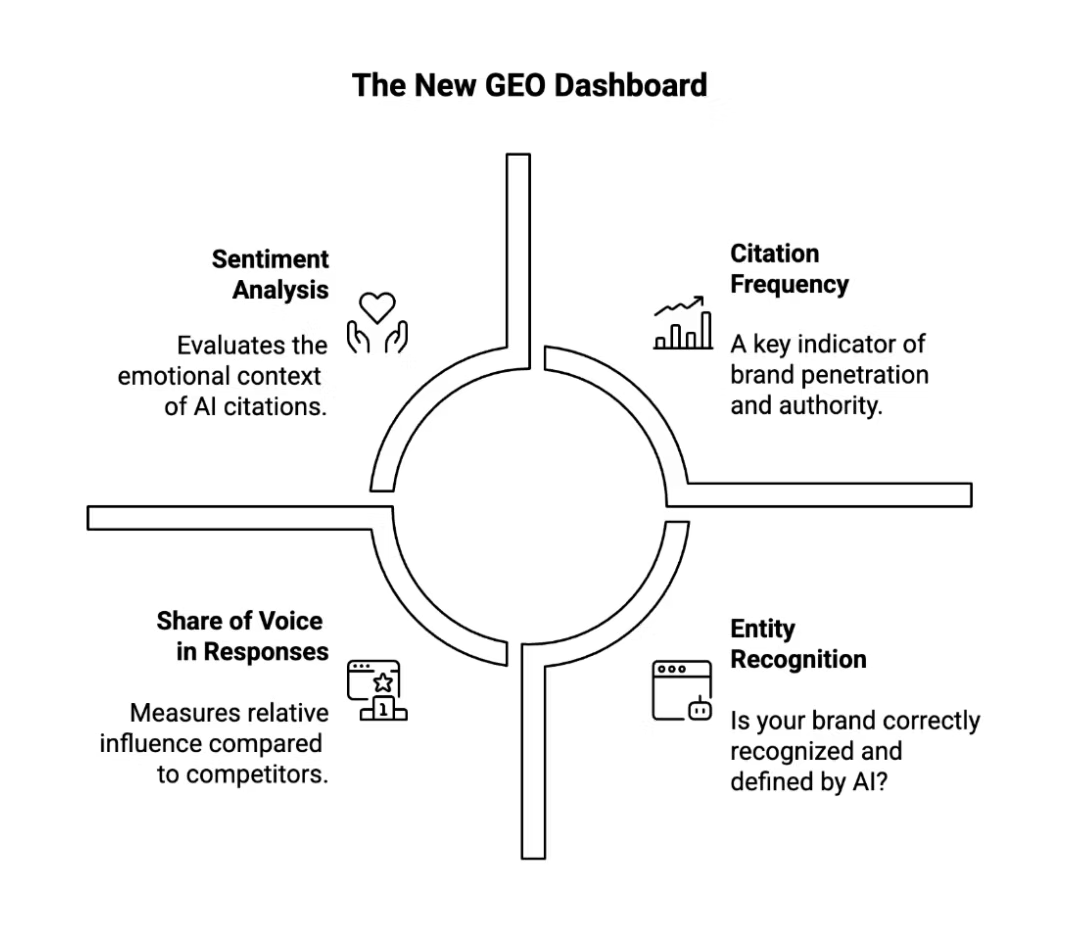
We built Echo (echo-llm.com) precisely to provide daily tracking of what ChatGPT, Perplexity, Gemini and Google AI Mode say about your brand: mentions, sentiment, citations, share of voice. It is a trend-monitoring tool, not a ranking oracle.
The consequence of this irreducible uncertainty is strategic: you cannot optimize for a specific query in an LLM. You cannot control the context in which your brand will be evaluated.
The only valid response to this uncertainty is brand robustness. An identity so clear, so coherent, so well documented inside and outside your domain that regardless of the prompt or model, you are the obvious answer.
That is why GEO, as a standalone discipline, is a useful fiction but intellectually inaccurate. What produces durable AI visibility is good marketing, good positioning, and good engineering. Three disciplines that predate LLMs and that find their full rigor here.
The operational plan
Step 1: Measure the real state. Before any action, establish a baseline. What is your share of voice on your strategic queries? What sentiment is associated with your brand? Which competitor is systematically cited in your place? Echo provides this diagnostic continuously.
Step 2: Audit your content architecture. Do your silos cover the real fears of your market (FUDs) and the outcomes your clients seek (JTBD)? A site organized by features responds to your internal logic, not to the needs of your prospects.
Step 3: Deploy the knowledge graph. Implement JSON-LD with @id, @graph and sameAs across the entire domain. Create or consolidate your presence on platforms that LLMs use as references: Wikidata, LinkedIn, Crunchbase.
Step 4: Produce irreplicable brand content. Redirect your editorial production toward what only you can document: proprietary data, precise case studies, argued positions on your market.
Step 5: Build your external presence. Industry press, podcasts, forums, collaborations with recognized experts. Every external mention is a vote of confidence that LLMs register.
AI visibility is the result, not the objective. The objective is to become an indisputable entity in your domain, sufficiently documented, coherent and differentiated that an LLM, faced with a question that concerns you, has no other plausible answer than you.
This work has no shortcut. But it has a clear structure. And for companies that execute it now, while their competitors are still looking for GEO hacks, the lead taken is difficult to close.

Founder of Schneider AI. Author of the #1 Best-Seller “Being Chosen by AI.” Co-founder of Aimwork. Creator of Echo.