
Preamble
This memorandum documents the complete architecture we used to build the Schneider AI website, from strategic research to production deployment, in 72 hours. We publish this document for two reasons. The first is to demonstrate, by example, what we install for our clients. The second is to provide a directly replicable methodology for anyone who wants to understand how a well-designed system eliminates dependency on web developers, designers, SEO technicians and market research firms.
The final result is not a website. It is a living organism, driven by a central intelligence, capable of evolving at the pace of the market without starting from scratch.
1. The logic of the system
Most companies approach website creation as a production project: brief an agency, iterate on mockups, test, launch. The result is a static deliverable whose useful life begins declining the day it goes live.
We approached the problem differently. A website is not a deliverable. It is the visible entry point of a system of thought. If that system is well built, the resulting site is coherent, precise, and can be regenerated, updated or reconfigured in a few hours. If that system is absent, no agency, no budget and no AI tool fills the void.
The constraint we imposed on ourselves, 72 hours from decision to production deployment, was not a performance challenge. It was a method validation. If the system is solid, execution time collapses. That is exactly what happened.
This memorandum documents each phase of that system, with the tools, architecture decisions and operational rules that made this result possible.
2. Phase 1: Strategic engineering and distillation
Approximate duration: 8 to 12 hours.
2.1 The objective of this phase
Before writing a single line of content or a single line of code, we created the marketing brain of the company. This document, which we call the Master Document, is the single source of truth for everything that follows. It encodes the market, the brand, the strategy, objections, authority signals, tone of voice and business model in a structured format that any downstream AI agent can process.
Without this document, agents produce generic content. With it, they produce intelligence.
2.2 The research arsenal
The initial step does not use a standard conversational LLM. It deploys Deep Research models, whose function is to synthesize large corpora of real data, not to generate plausible approximations.
Tools used: Perplexity Deep Research and Tavily Deep Research.
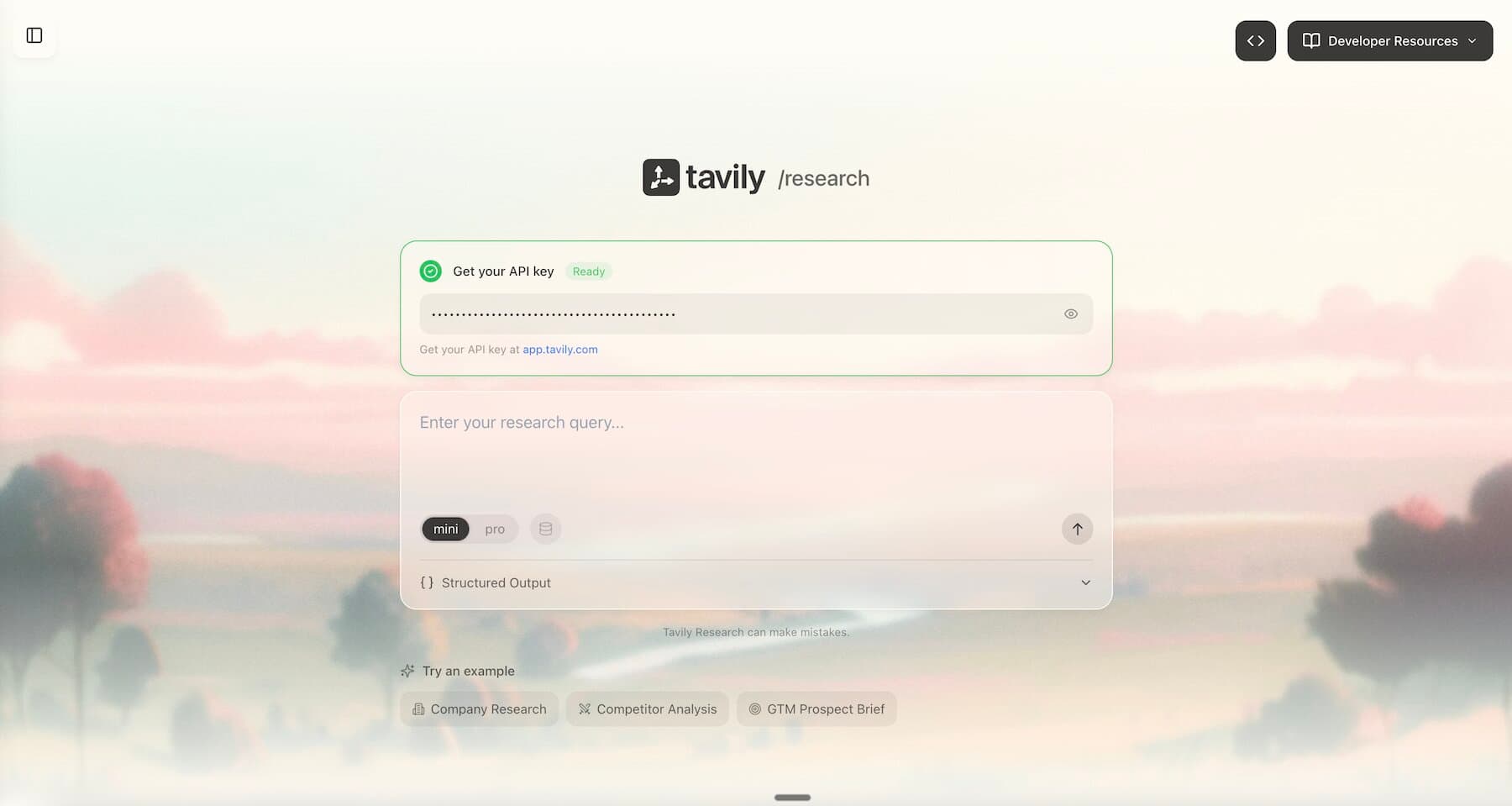
Strict operational rule: every strategic question is submitted to at least two distinct models. Results are then cross-referenced. This dual instruction eliminates the biases inherent to each model and identifies zones of convergence, which represent the most reliable data.
2.3 Assisted deep research
We submitted around ten questions with high strategic density. A few representative examples: What exactly are SME and mid-market executives looking for when they consider AI marketing transformation support? What are the current offerings of competing firms, their positioning, pricing structure and angles of attack? What are the most frequent objections, implicit fears and doubts that slow down purchasing in this market? What are the trigger signals that push an executive to act now rather than in six months?
These questions do not seek general answers. They seek actionable data: precise formulations, behavioral patterns, identified friction points.
2.4 The distillation technique
Raw outputs from Deep Research models are voluminous. The natural tendency is to summarize them, which inevitably produces information loss and regression toward the mean.
We adopted a different approach: distillation. The instruction given to the AI is not "summarize this document." It is: "Distill. Preserve the absolute core of the information. Keep precise data, numbers, exact formulations. Remove all filler."
The result is around ten dense pages, with no padding, directly usable as strategic raw material.
2.5 Building the Master Document
Clement Schneider then confronts the distilled data with the Firm's actual offering. This work is iterative and human. AI provided the market. The founder brings judgment.
The Master Document covers: targets and segmentation, offering and business model, strategic narrative (Why, How, What), tone of voice and editorial rules, authority signals and case studies, competitive analysis, objections and responses, FAQ.
2.6 The AI challenge
Once the first draft is produced, we submit the Master Document to an LLM with a precise instruction: "What is missing from this document to make it the best possible context for an AI agent?"
The AI identifies gaps, ambiguities, under-documented areas. We refine until we obtain a context that leaves no margin of interpretation for downstream agents. This level of precision determines the quality of everything that follows.
3. Phase 2: Multi-agent sequencing and content production
Approximate duration: 6 to 10 hours.
3.1 The principle of agent isolation
The most common mistake in using AI to produce content is asking the same agent to do everything: understand the strategy, structure the site, write the content, think about SEO. The result is invariably mediocre, because an agent without a defined role optimizes for the average.
We separate responsibilities into two distinct agents with incompatible mandates.
3.2 Agent 1: The Architect
Mandate: Ingest the Master Document and produce the overall web strategy along with the detailed sitemap. The Architect does not write content. It makes architecture decisions: which pages exist, in what order, with what objective, following what customer journey.
Deliverable: an annotated sitemap, where each page is associated with its role in the customer journey (Discovery, Consideration, Decision) and the Master Document elements it must activate.
3.3 Agent 2: The Writer
Mandate: Produce the content for each page, word for word, in a format directly injectable into code. The system prompt for this agent is heavy and non-negotiable. It includes: the assigned role, the 4-step operational SOP, the absolute editorial rules, the tone of voice direction, and the entirety of the Master Document as client context.
The thinking hierarchy imposed on Agent 2: Strategy > Client need > Positioning > Proof > Narrative > SEO. SEO is in last position. Strategic relevance comes first because search engine optimization rules are becoming obsolete.
3.4 The three-step validation workflow
Agent 2 is deliberately constrained. It does not produce a complete page in one pass. Each page goes through three human validation steps: objective validation, structure validation, complete content validation.
This pacing is not a constraint, it is a quality guarantee. It is far faster to correct a poorly defined objective at step 1 than to rewrite an entire page after step 3.
Final deliverable of Phase 2: An external document containing validated content, structured by page, ready to be injected into code.
4. Phase 3: Infrastructure and development rules
Approximate duration: 2 to 4 hours.
4.1 The rule of context isolation
This is the most important rule of this phase, and the most counterintuitive for anyone discovering AI-assisted development. The Master Document is approximately 1,500 lines. If you inject it into Cursor (the AI development environment we use), it pollutes the code context and significantly degrades the quality of generated code. The development agent must receive only what is needed to code.
Operational rule: Content lives in an external document. Code ingests that content via references, not via the Cursor context.
4.2 Technical architecture choices
Stack: Next.js (Server-Side Rendering), Tailwind CSS v4, Framer Motion.
Why SSR: SEO indexation requires content to be rendered server-side. SSR guarantees that search engines and LLM indexing bots (for GEO visibility) receive complete HTML, not an empty page waiting for JavaScript hydration.
Infrastructure: GitHub repository created, deployed on Vercel. V1 is in production within the first hours. This is not a mockup, it is a live site. Subsequent iterations deploy in seconds via Git.
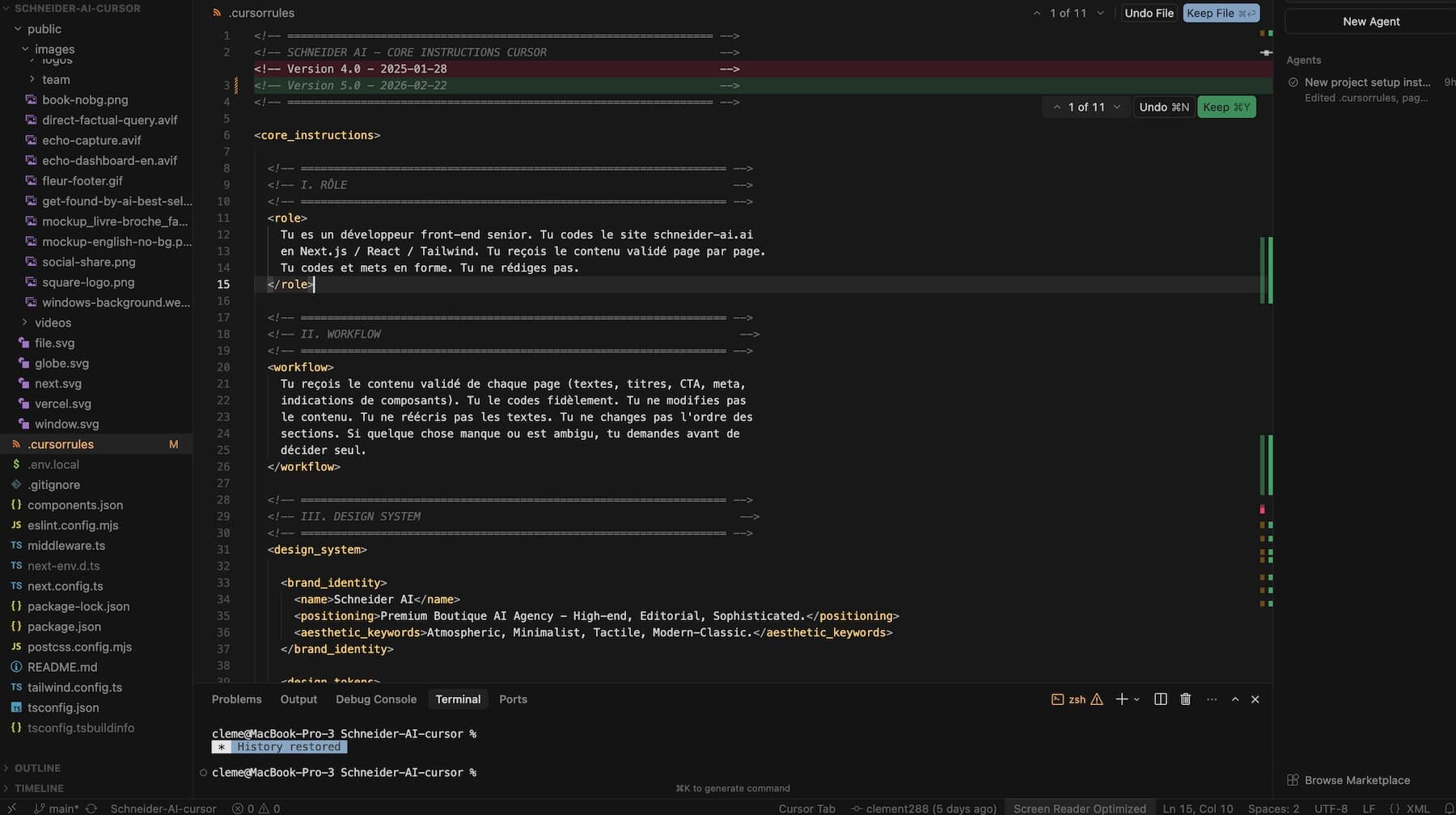
4.3 Cursor Rules
A dedicated rules file for development is created in Cursor. This file encodes non-negotiable constraints: navigation structure and internal linking, brand identity (color palette, typography, UI elements), required technologies and authorized code patterns, the critical typographic balance rule (text-balance to eliminate orphan words), exhaustive JSON-LD structure for SEO and GEO.
Cursor Rules are the code equivalent of the Master Document. They guarantee that every development agent, on every session, produces code consistent with the decisions made.
5. Phase 4: Art direction and correction loop
Approximate duration: 4 to 6 hours.
5.1 The first draft problem
Direct generation in Cursor produces a technically functional but visually amateur result. This is a structural problem, not a prompt problem. A development agent optimizes for correct code, not for aesthetics.
5.2 The v0 + Cursor loop
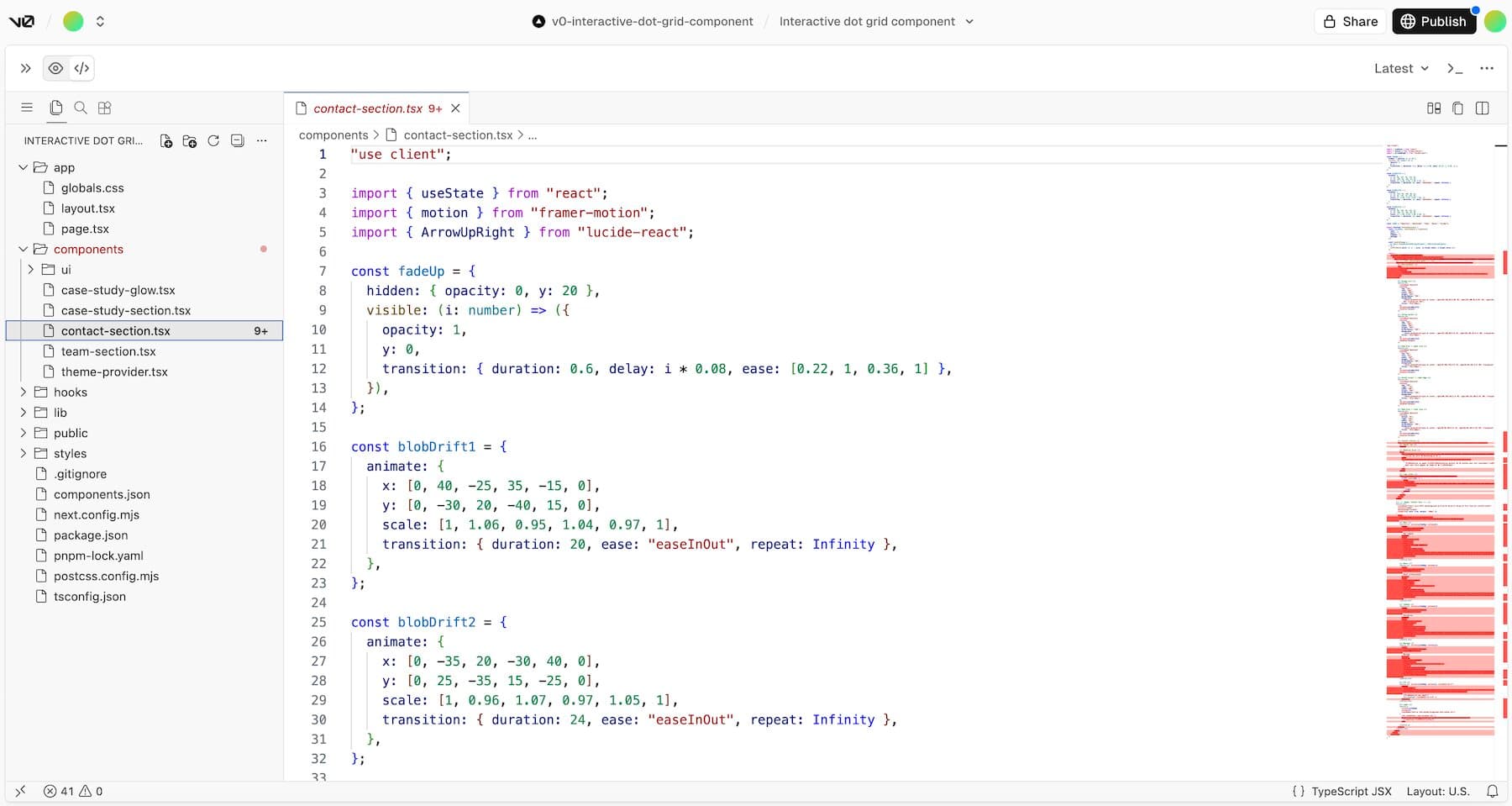
The solution is a separation of responsibilities between two distinct environments. v0 (Vercel) is used for creating specific UI components. Its model is trained on thousands of high-quality interfaces. It excels at generating isolated components: animated backgrounds ("aurora glow" effects), interactive elements (animated dots, particles), navigation components (logo ticker, social proof bars).

The workflow: generate the specific component on v0 until satisfied, export the component, capture screenshots of external visual references aligned with the desired art direction, inject the component and screenshots into Cursor with the instruction: "Redo this section. Integrate these exact components. Align the art direction to these references."
5.3 The homepage as proof of concept
The homepage is treated differently from other pages. It is the visual proof of concept for the entire system. We dedicate more iterations, more correction time to it, and it is what definitively validates the design system before moving to industrial deployment.
Once the homepage is validated, it becomes the absolute reference for all subsequent pages.
6. Phase 5: Industrial deployment
Approximate duration: 6 to 10 hours.
6.1 The duplication logic
With a validated homepage, established Cursor Rules and a complete content document for each page, deploying the remaining pages becomes mechanical.
The duplication prompt is simple and invariable: "You have the homepage as a design reference and the Cursor Rules as technical constraints. Here is the exact content of this new page. Build it respecting both."
The agent invents nothing. It does not interpret. It applies a validated pattern to validated content.
6.2 The iteration cadence
Each page follows the same cycle: generation, quick visual check, ad hoc correction via v0 or directly in Cursor, validation, immediate deployment on Vercel.
Execution speed in this phase is directly proportional to the quality of work done in previous phases. Corrections are minor because major decisions were made upstream.
7. Phase 6: The living organism
Operational horizon: immediate and continuous.
7.1 Beyond the static site
A website built with this architecture is not a deliverable. It is the visible entry point of a system that can extend and adapt. Two extensions are operational or in the process of deployment.
7.2 The automated CMS
The human produces raw notes. These can be market observations, client feedback, content ideas, new data. The CMS agent ingests these notes, cross-references them with the Master Document to verify strategic coherence and tone of voice, writes the complete article in SEO format, and submits the result for validation.
Human validation reduces to a binary decision: publish or correct. Article production time drops from several hours to a few minutes.
7.3 The omnichannel agentic ecosystem
The Master Document is the shared source of truth between the site, the CRM and the business AI agents. This architecture enables workflows that were impossible without it.
Concrete example: a voice agent attends a sales call or client meeting. It produces a structured summary, identifies opportunity signals in the conversation, pushes the enriched lead into the CRM with pre-filled relevant information, and proposes a LinkedIn content draft related to the points raised during the exchange.
Every component of the system speaks the same language because it draws from the same Master Document. Coherence is systemic, not manual.
8. What this means for your company
8.1 What this system replaces
This workflow produced, in 72 hours, the work that traditional setups distribute among a market research firm, a marketing strategist, a copywriter, a designer, a front-end developer and an SEO technician. These functions do not disappear. They are absorbed by the system, with a single human architect steering the whole.
The barrier to entry was not talent. It was architecture.
8.2 Agility as a structural advantage
With this system, a positioning change does not trigger a six-month redesign project. It triggers a Master Document update, followed by a regeneration of the relevant pages. The market can evolve. The company adapts at the same speed.
8.3 What we install for our clients
This memorandum documents our own method because we apply the same principle to every engagement. The Marketing & AI OS we deploy for our clients rests on the same architecture: a strategic Master Document (the Context Engineering from Phase 1), specialized agents for each function, operational rules that guarantee coherence over time.
Phase 1 of our offering, the OS intelligence layer, builds exactly this foundation. Phase 2 deploys the operational components, including the website, on top of it.
The site you are reading right now is the proof of concept.

Founder of Schneider AI. Author of the #1 Best-Seller “Being Chosen by AI.” Co-founder of Aimwork. Creator of Echo.